
The First 5 Things I Look For When I Walk Into a Messy Startup
How I can usually diagnose operational chaos in under an hour.

When founders reach out to me, they usually think they need help with something specific.
“Can you fix our CRM?”
“We need better onboarding.”
“Our teams just need to communicate better.”
Sometimes that’s true, but most of the time the real issue shows up long before we open a dashboard or a tool.
Within the first hour, a few signals tell me how a company actually runs.
Not how someone tells me it runs.
How it runs when no one is looking.
Here are the first five things I check.
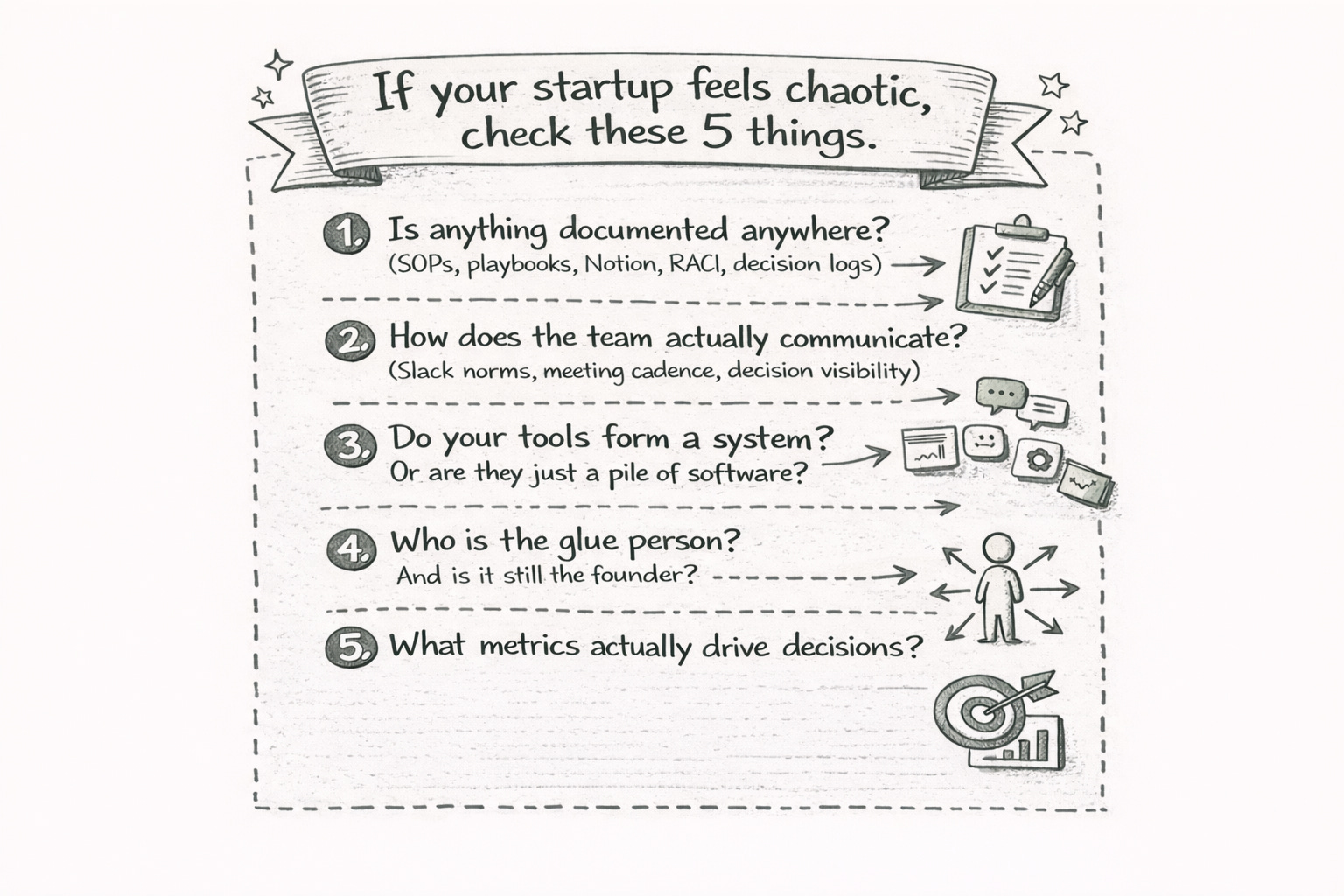
1. Is anything documented anywhere?
I usually start with a very simple question:
“Where do you keep documentation?”
Sometimes the answer is Notion.
Sometimes Google Docs.
Sometimes a messy internal wiki.
Other times, the answer is silence and a shy smile.
Early-stage companies often run on tribal knowledge.
Everyone “just knows” how things work.
Until someone leaves, a new hire shows up. or a customer asks a question that only one person can answer.
I’m not a monster; I am not looking for perfect SOPs, but I am looking for any signal that the company believes systems matter.
Even a rough manual, a messy playbook, or a half-built RACI framework tells me something important:
Someone has started turning knowledge into infrastructure.
If nothing is documented anywhere, the company isn’t scaling yet. They are a team of improvisers.
2. How does the team actually talk to each other?
Next, I look at the team’s actual communication. Not what one leader tells me.
Do they have recurring leadership meetings?
Is there a weekly cadence where teams align?
Or does everything happen in Slack at random times of day?
I’ve said this many times, but Slack is one of the fastest ways to understand a company.
Sometimes it’s organized:
• clear channels
• decisions summarized
• threads used well
Other times it’s a stream of chaos with questions flying everywhere. decisions buried in threads, and the founder answering everything.
If a company doesn’t have clear communication rhythms, the founder becomes the router for every decision.
Which leads us to the next signal.
3. What tools are you using?
I always ask founders to walk me through their stack.
It usually sounds something like this:
HubSpot.
A support tool.
Stripe or billing software.
Product analytics.
A project management tool.
A knowledge base.
And then a few more tools snuggled their way in over time.
The tools themselves aren’t the problem.
What I’m really looking for is this:
Do these tools reflect a system… or a series of reactions?
Many early-stage companies accumulate software the way people accumulate kitchen gadgets. (And I am not judging, I LOVE a good kitchen gadget. Hello Ninja blender.)
Something broken? They add a tool that promises to fix it all fast.
Six months later you have:
• automations firing everywhere
• fields missing data
• marketing capturing information sales never uses
• customer success rebuilding context manually
At that point, the company doesn’t have a tech stack.
You’re looking at tool soup. (More on that here.)
4. Who is the glue person?
This question reveals almost everything. Every company has someone who holds things together.
The question is who. Sometimes it is the founder themselves. Other times it’s the stable operator. (Hi, hello, this was me.)
Whoever it is, it creates a hidden operating model where every question, need, and decision flows through one person.
The glue becomes the connective tissue for:
• sales questions
• customer escalations
• internal alignment
• product context
Which feels efficient.
Until growth makes it impossible.
The goal isn’t to eliminate that glue.
It’s to turn it into structure the company can use without the founder (or that person).
5. What metrics does the company actually run on?
This is the last thing I check.
No, not what metrics appear in decks. The ones that drive team behavior.
Does the company have a clear North Star?
Do teams know how their work contributes to it?
Are there OKRs or operating goals connected to that number?
Or are people just busy all the time.
This is where many early-stage companies struggle.
Teams are working hard, but they’re not always moving in the same direction.
When metrics are unclear, progress becomes subjective. Which means decisions start happening based on instinct instead of shared targets.
The mistake I see founders make most often
When companies notice these problems, the instinct is usually the same.
Hire someone.
A new head of marketing.
A sales leader.
A RevOps person.
If the structure isn’t there yet, those hires inherit confusion instead of momentum.
Now instead of one overwhelmed founder…
You have multiple capable people trying to operate inside a system that hasn’t been defined.
Hiring doesn’t fix that, but a clear stable system? Now THAT can fix a lot.
What founders usually want when they bring me in
Most founders really don’t want a big operational overhaul.
They want the company to move faster, but what they’re really asking for is something simpler.
They want to stop being the bottleneck.
They want their teams to operate without needing them in every conversation.
They want the company to feel less fragile.
That’s what good operations does.
It turns founder knowledge into company capability.
A quick question to ask yourself
If you stepped away from your company for a week…
What would stall?
That answer usually reveals exactly where the structure is missing.
I have two advisory slots open if you want a friend to share a little of that mental load.
All great points, the first thing I thought of was the quality of documentation so I'm glad we're on the same page.
This is a great assessment checklist! I'm sure these teams are running much more smoothly after you come into the picture.